
RushesAn Open-Source Screen Recorder for People and AI Agents
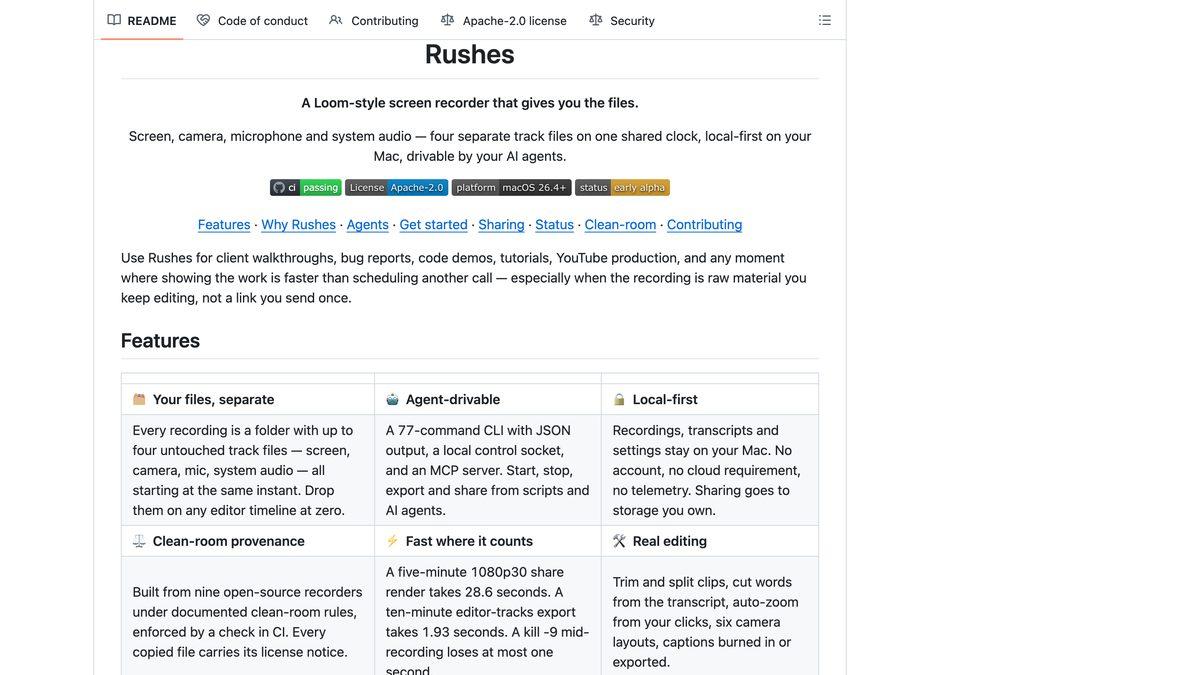
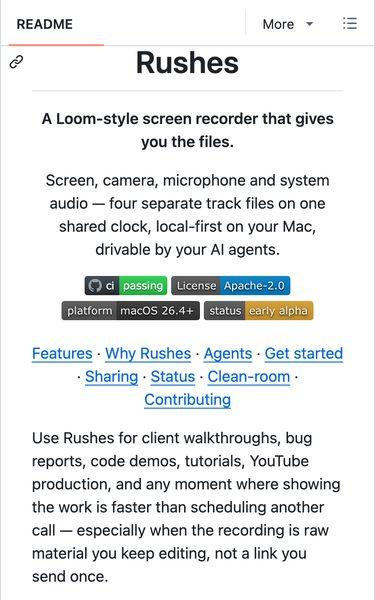
A Loom-style Mac screen recorder that saves screen, camera, microphone and system audio as four separate files on one shared clock, keeps everything local, and can be run by AI agents through a 77-command CLI.
Built with Swift 6, ScreenCaptureKit, Electron, React, TypeScript, MCP, Cloudflare Workers, Cloudflare R2.
4 tracks
Screen, camera, mic and system audio, each its own file on one clock
77 commands
Self-describing CLI with JSON output that AI agents can drive
28.6 s
To render a five-minute 1080p30 share video
What it is
Most screen recorders hand back one mixed file, or a link to a copy in someone else's cloud. Rushes treats a recording as footage. Each take is a folder holding up to four untouched track files that all start at the same instant, plus a manifest, an input event log, and transcripts and captions as they are produced. A Swift engine does the capture and serves a local control socket. An Electron and React desktop app gives the menu-bar recorder, camera bubble, review window and exports. Every action is also a command: a 77-command CLI with JSON output and an optional local MCP server let Claude and other agents record, verify and export. Share links upload to storage the user owns, such as Cloudflare R2, and play on a small viewer page with captions and a clickable transcript.
The problem
Recordings used for tutorials, bug reports and YouTube are raw material that gets edited again and again. A single baked file loses the separate tracks, a force-quit can lose the take, and a cloud-only tool puts the footage on someone else's servers.
What I built
Fragmented writers lose at most one second of each track on a crash, and a relaunch recovers the take. Pauses stay honest: a 60-second take with two 10-second pauses verifies at 40.03 seconds on every track, within 50 ms. Transcription, titles and chapters run on the device. The design came from clean-room research on nine open-source recorders, and a CI check fails the build if any copied code lacks its license notice.
What happened
Public on GitHub under the Apache-2.0 license, in early alpha. The engine, desktop app, review and sharing phases are built and benchmarked; a five-minute 1080p30 share render takes 28.6 seconds.
What it changed
- Recordings stay on the user's Mac unless they choose to share
- Editors and agents get clean source tracks instead of a single baked file
Who it fits
- Client walkthroughs, bug reports and code demos
- YouTube and tutorial production where the footage is edited later
- AI agents that need to record and verify a screen session
- Crash-safe fragmented writers that lose at most one second per track
- Local control socket with a thin CLI client and an optional MCP server
- On-device transcription, titles, chapters and captions
- Self-hostable sharing on the user's own Cloudflare account
- Clean-room provenance enforced by a CI check
Want something like this built?
Bring the job that eats your week. Step 1 is a free 15-minute fit call. Step 2 is the AI Staff Assessment, $500, a written assessment you keep. Step 3 is your first hire at a published price, or you take the assessment and stop.