moHelpVoice-First AI Home Repair Guide
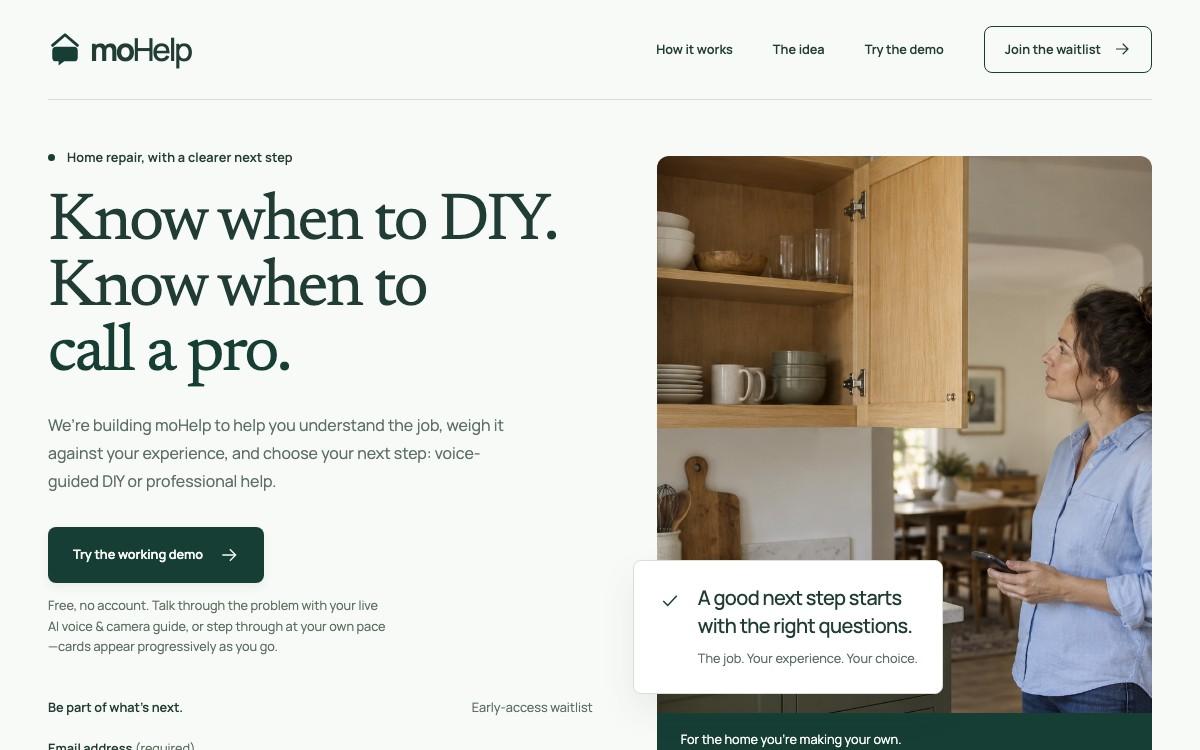
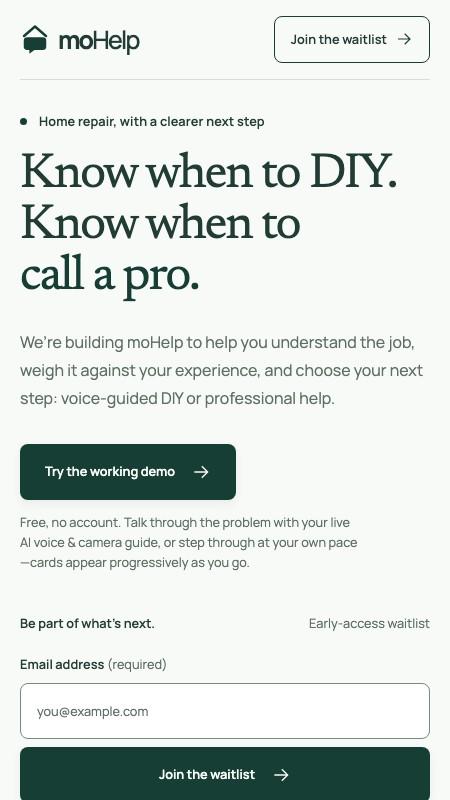
A revival of my earlier home-repair startup, rebuilt with real-time AI: point your camera at a repair and talk to a live voice and avatar guide that checks whether the job is safe to DIY, builds your tool and material checklist with local hardware store pickup, and walks you through one step at a time.
Built with Next.js 16 (Vinext), React 19, TypeScript, Cloudflare Workers, Cloudflare D1, Drizzle ORM, OpenAI GPT-Live, OpenAI Vision, HeyGen LiveAvatar, LiveKit WebRTC, Capacitor (iOS & Android), Playwright.
Voice-First
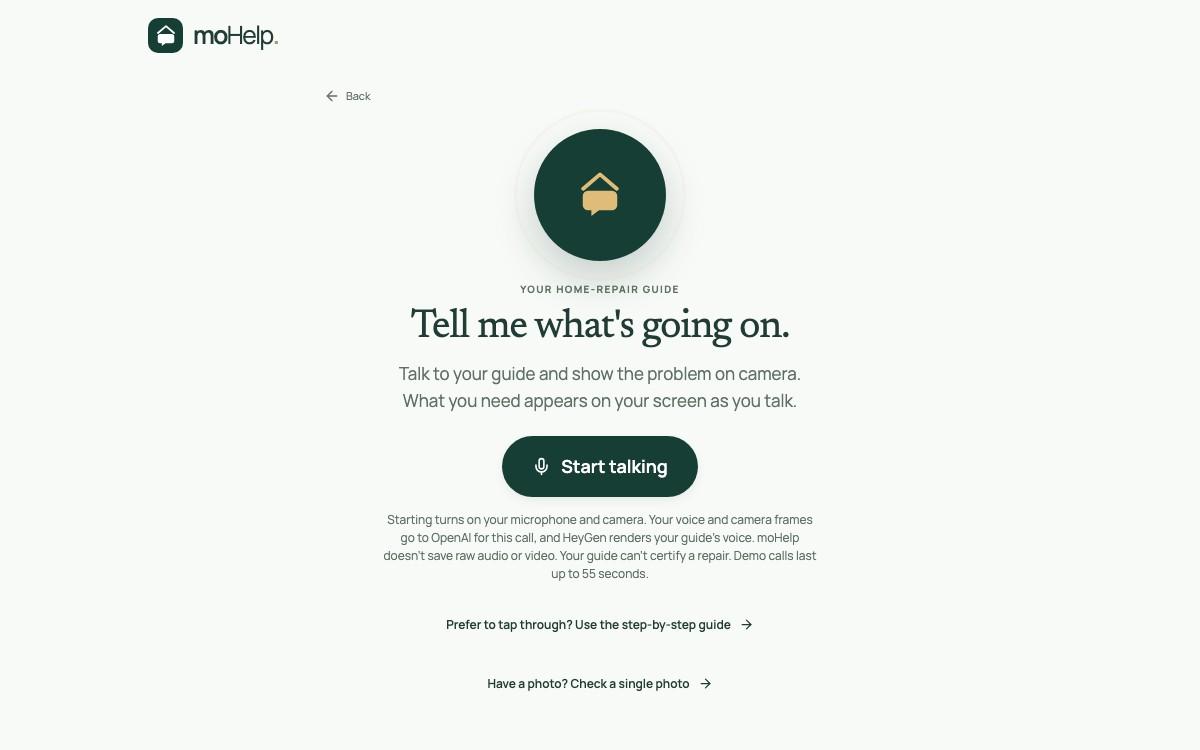
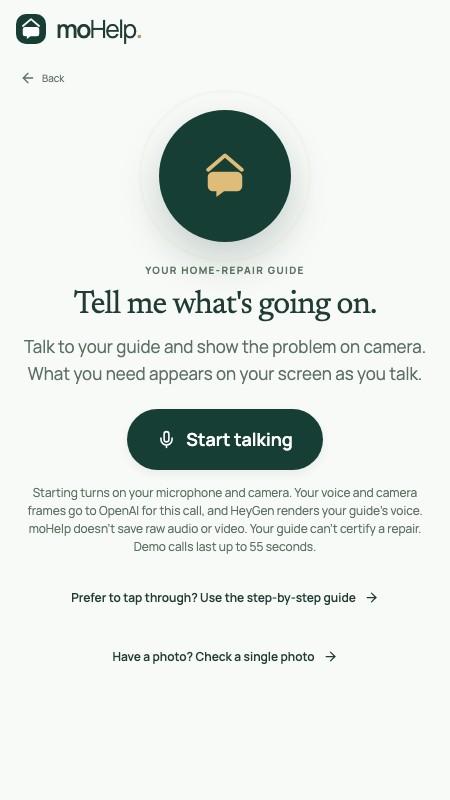
Hands-free GPT-Live voice and camera guide with progressive one-card-at-a-time disclosure while you hold the tool
Tool Garage
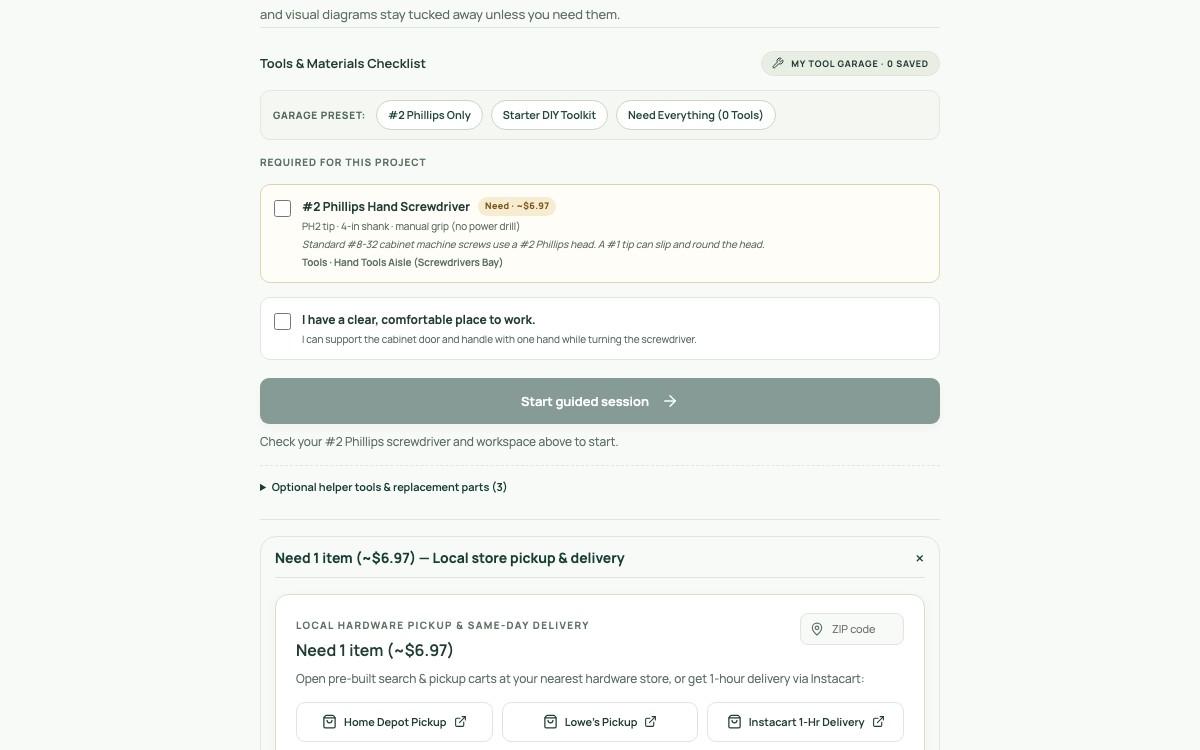
Remembers the tools you already own and builds Home Depot, Lowe's, and Instacart pickup or delivery links for missing parts
2D Callouts
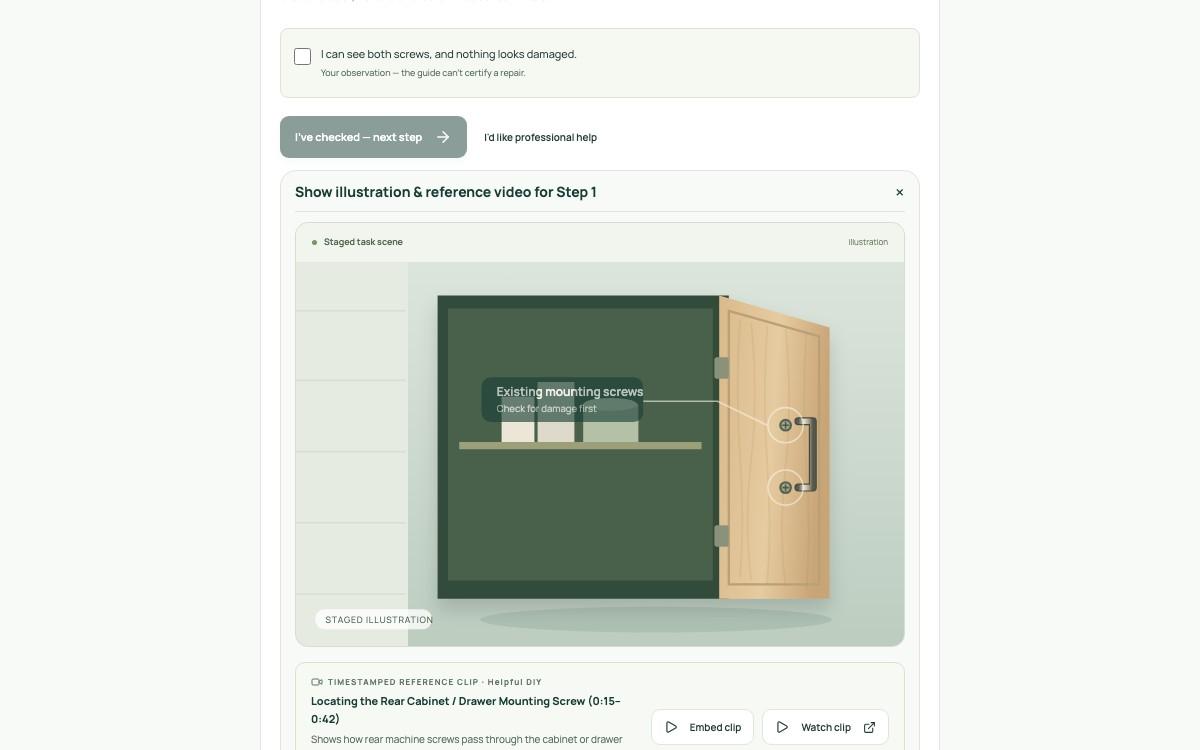
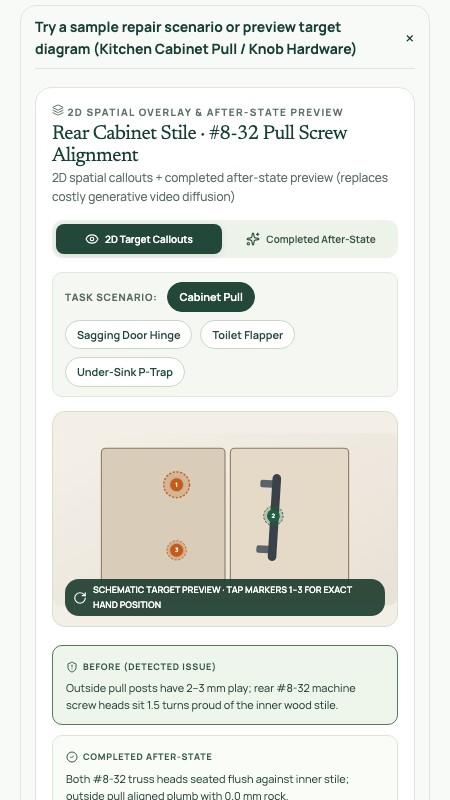
Vision-anchored target rings, rotation arrows, timestamped pro clips, and a safety gate that halts when a job needs a pro
What it is
I originally built moHelp years ago to connect homeowners with live video help from contractors. In October 2026 I revived the product around real-time multimodal AI at getmohelp.com. A homeowner points their camera at a loose cabinet pull, sagging door hinge, running toilet flapper, or under-sink P-trap and talks hands-free to a live voice and video guide. Instead of dumping a wall of text on a small phone screen while someone is holding a screwdriver, the interface uses progressive disclosure: cards appear one at a time as you talk, starting with what the camera sees, a quick readiness and safety check, a tool and material checklist matched to what you already own in your garage, and one step card at a time with timestamped reference clips and 2D target callouts.
The problem
Homeowners staring at a small repair have to answer two questions before they touch a screw: can I safely do this myself, and do I actually have the right tool and part size on hand. Traditional video tutorials run for ten minutes, skip safety prerequisites, and leave your hands full trying to scrub back and forth on a phone. Meanwhile, generating real-time AI video of a repair on the user's camera is slow, expensive, and prone to mechanical hallucinations like turning a fastener the wrong way.
What I built
I built a voice-first web and Capacitor mobile app running on Cloudflare Workers and D1. A server-side WebSocket bridge streams 24 kHz microphone audio and camera snapshots to OpenAI GPT-Live for full-duplex speech while an asynchronous vision worker inspects frames, checks a deterministic safety allowlist, and returns structured tool calls. Voice output streams into HeyGen LiveAvatar over LiveKit WebRTC (with an Anam audio-passthrough option and an animated 2D guide fallback). Instead of hallucinated generative video, visual guidance uses fast 2D spatial callout rings and directional arrows anchored to the user's photo, an after-state preview, and oEmbed-verified YouTube reference clips cued to the exact start and end seconds for each step. Before step one unlocks, an interactive My Tool Garage checklist compares required tools and fasteners against what the homeowner already owns and generates one-click Home Depot pickup, Lowe's pickup, and Instacart one-hour delivery links plus a copyable aisle spec card. If a screw is stripped or a job crosses a safety boundary, the guide stops and prepares a structured contractor handoff brief.
What happened
Live at getmohelp.com with the landing page, early-access waitlist on Cloudflare D1, the minimal single-column voice-first demo, the photo assessment workflow, and iOS and Android builds via Capacitor. Automated unit and Playwright end-to-end tests verify the voice bridge, progressive card disclosure, tool-garage filtering, store cart links, and oEmbed reference clips.
What it changed
- Revives an earlier contractor-video startup with a self-serve AI guide that works on demand without scheduling a live tradesperson
- Helps homeowners decide honestly between a five-minute DIY fix and calling a professional before they strip a screw or force a part
- Turns missing tools and fasteners into pre-built local hardware store pickup and one-hour delivery carts before the repair starts
Who it fits
- A homeowner checking whether a loose cabinet handle, sagging door hinge, or running toilet flapper is a safe five-minute fix
- First-time homeowners who need to know which screwdriver tip or machine screw size to buy before starting
- Anyone working with both hands who needs spoken step-by-step guidance and a quick visual check without touching the screen
- Renters or landlords preparing a clear, structured repair brief to hand off to a local handyman or contractor
- Cloudflare Worker WebSocket bridge streaming 24 kHz PCM16 audio and camera frames to OpenAI GPT-Live with asynchronous vision delegation
- Server-relayed LiveAvatar and LiveKit WebRTC room orchestration with zero API keys exposed in browser or mobile bundles
- Voice-first progressive disclosure shell that starts with zero clutter and reveals readiness, supply, and step cards only as the conversation reaches them
- My Tool Garage state engine with one-click Home Depot pickup, Lowe's pickup, Instacart same-day delivery deep links, and a copyable aisle spec card
- Vision-anchored 2D SVG spatial callouts, after-state preview, and transcript-verified YouTube IFrame clips bounded to exact start and end timestamps
- Shared web and Capacitor 8.5 iOS and Android codebase with atomic D1 session admission and CSRF origin guards
Want something like this built?
Bring the job that eats your week. Step 1 is a free 15-minute fit call. Step 2 is the AI Staff Assessment, $500, a written assessment you keep. Step 3 is your first hire at a published price, or you take the assessment and stop.